Airports and flights
Why airport codes don't match their cities: ORD, LAX, YYZ and more
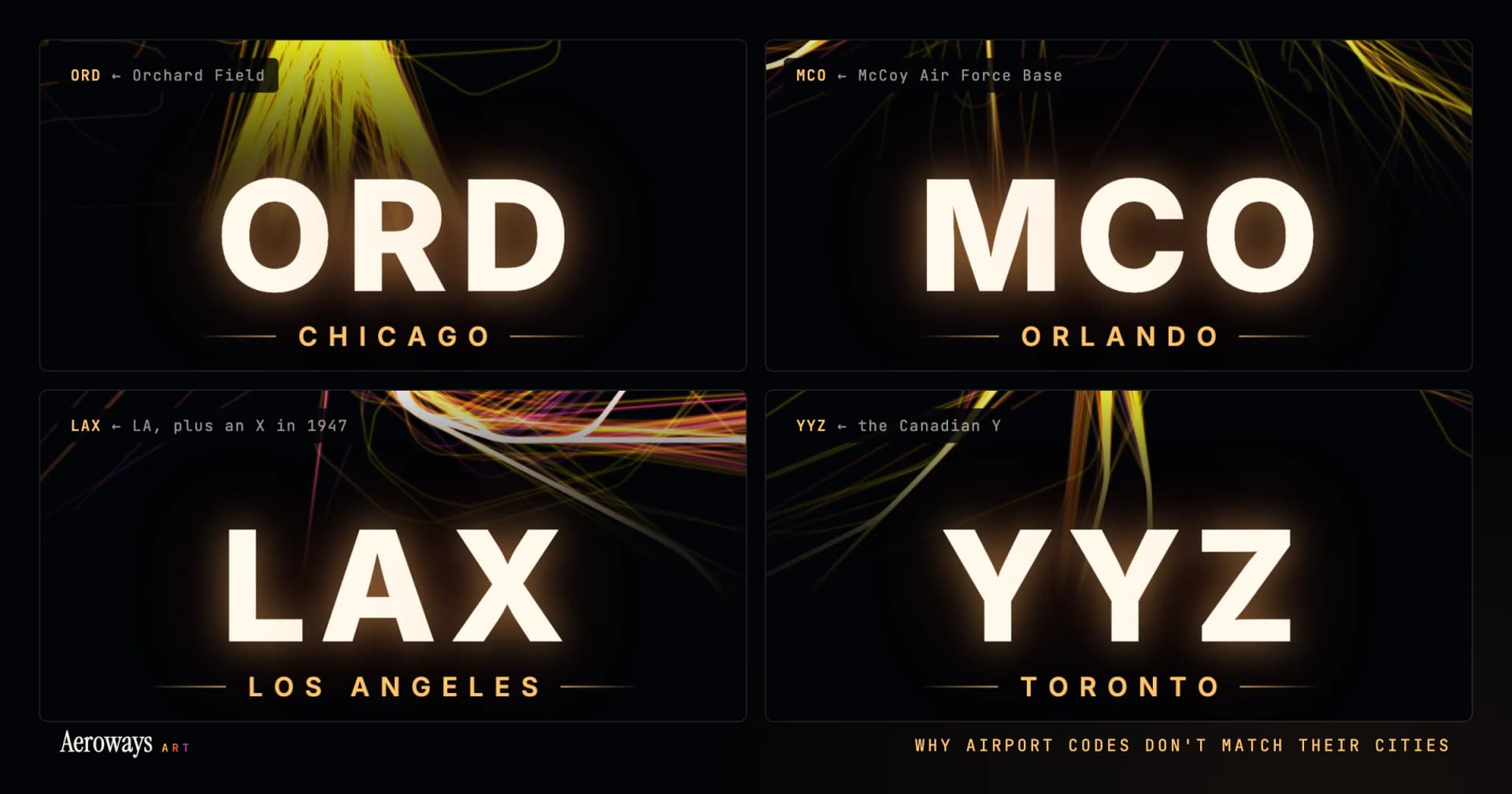
Most airport codes that don't match their city are older than the airport's name. Chicago O'Hare was Orchard Field, so it is ORD; Orlando's code comes from McCoy Air Force Base, so it is MCO. Codes are meant to be permanent, so they outlive the names they came from. Most of the rest come from letters that were already taken or set aside.
Updated 29 October 2026
How airport codes are chosen
The three letters on your boarding pass and bag tag are an IATA location code. IATA, the airlines' trade association, hands them out under its Resolution 763, and only when an airline asks: usually the first airline to fly to a new airport. The rule is simple. The first choice is the first three letters of the place's name. If those are taken, the next choice is a free combination, preferably starting with the place's first letter. Every code must be unique, and with about 11,300 of some 17,000 possible combinations already in use, the obvious letters are often gone.
Codes also have to last. IATA treats them as permanent and changes one only for a strong reason, usually safety. So when an airport is renamed, or its city is, the code stays as it was.
That leaves three kinds of codes that don't match their city: codes from an old name, codes that had to avoid letters already taken or set aside, and codes from somewhere other than the city itself.
Codes named after the airport's old name
Many of the best-known mismatches spell a name the airport no longer has.
| Code | Airport | Where the letters come from |
|---|---|---|
| ORD | Chicago O'Hare | Orchard Field, its name until 1949 |
| MCO | Orlando | McCoy Air Force Base, closed in 1974 |
| MSY | New Orleans | Moisant Stock Yards |
| BNA | Nashville | Berry Field Nashville, after its first administrator |
| MCI | Kansas City | Mid-Continent International, its first name |
| GEG | Spokane | Geiger Field, its name until 1960 |
Chicago chose Orchard Field for its new airport in 1945 and renamed it in 1949 after Edward "Butch" O'Hare, a naval aviator. New Orleans began commercial flights at Moisant Field, named after the aviator John Moisant, in 1946. Orlando's code comes from McCoy Air Force Base, which closed in 1974; the airport became Orlando International in 1976. In each case the airport changed its name and kept its letters.
Whole cities have been renamed under their codes too. Mumbai is still BOM, Chennai MAA and Kolkata CCU: the letters of Bombay, Madras and Calcutta. Beijing is PEK, from Peking; Ho Chi Minh City is SGN, from Saigon; and St Petersburg is LED, from Leningrad.
The X in LAX
In the 1930s airlines chose their own two-letter codes, and Los Angeles was simply LA. By the late 1940s there were too many airports for two letters, and the codes grew to three; Los Angeles became LAX in 1947. The X means nothing: it filled the third place. Newspaper histories say Portland's PDX and Phoenix's PHX gained their X the same way. IATA took over the codes from the airlines in the 1960s.
Letters that were already taken
In the US, some first letters were set aside before the airlines got to them. The FAA, which gives US airports their identifiers, does not hand out three-letter ones that start with N, W, Y or Z. N is the US Navy's. K and W begin the call signs the FCC gives radio and television stations, Q belongs to international telecommunications, and Z marks the FAA's own air route traffic control centres.
Most big US airports use the same three letters for the FAA and for IATA, so a US airport code starting with N or W is rare. Newark is EWR, and Norfolk is ORF.
Canada's Y
Almost every big Canadian airport starts with Y: Toronto Pearson is YYZ, Montreal YUL, Vancouver YVR and Calgary YYC. IATA dates the habit to before the Second World War and says it is believed to come from the two-letter codes of weather stations or radio beacons. It also says new Canadian codes no longer have to follow it.
Why Toronto is YYZ in particular has no official explanation. The stories online, most of them about an old weather station at Malton, where the airport stands, are just that: stories nobody has been able to confirm.
Codes from somewhere else
Some codes match a place, just not the city on the ticket.
- CVG, Cincinnati. The airport is in Boone County, Kentucky, across the Ohio River. Its code comes from Covington, the Kentucky city across the river from Cincinnati, because CIN was already taken.
- IAD, Washington Dulles. It was first coded DIA, and IATA changed it to IAD because DIA was too easily confused with DCA, Washington's other airport. It is IATA's own example of a code that had to change.
- WAS, Washington. Cities with more than one airport can have a code of their own: WAS covers DCA, IAD and BWI. A city with one airport shares its code, like Geneva's GVA.
IATA codes and ICAO codes: JFK and KJFK
Pilots and air traffic controllers use a different code: ICAO's four letters. ICAO, the UN's aviation agency, publishes them for airports commercial or not, for flight plans and air traffic control. The first letter is usually the region and the second the country: Barcelona's LEBL is L for southern Europe and E for Spain. Canadian airports start with C, as in CYYZ.
In the contiguous US, the ICAO code is a K in front of the airport's FAA identifier, so New York's JFK is KJFK and Chicago's ORD is KORD. Alaska and Hawaii have their own prefixes: Honolulu is PHNL.
The big letters on our prints are the IATA code, the one on the bag tag. Under them sits the city, and under that the date: how a day of real flights becomes the print above them.
Questions
Why is Chicago O'Hare's code ORD?
The airport was Orchard Field until 1949, when Chicago renamed it after the naval aviator Edward "Butch" O'Hare. The code kept the letters of the old name, because airport codes are almost never changed once assigned.
Why is Orlando's airport code MCO?
The code comes from McCoy Air Force Base, named after Colonel Michael N. W. McCoy. The base closed in 1974, the airport became Orlando International in 1976, and the code stayed MCO.
Why do Canadian airport codes start with Y?
The habit goes back to before the Second World War. IATA says it is believed to come from the two-letter codes of weather stations or radio beacons, and that new Canadian codes no longer have to follow it.
What does the X in LAX stand for?
Nothing. Los Angeles had the two-letter code LA, and when airlines ran out of two-letter codes in the late 1940s it became LAX, in 1947. Portland (PDX) and Phoenix (PHX) are said to have gained their X the same way.
Can an airport's code be changed?
Very rarely. IATA treats its codes as permanent and changes one only for a strong reason, usually safety. Washington Dulles was first coded DIA and was changed to IAD, because DIA was too easily confused with DCA, Washington's other airport.
What is the difference between IATA and ICAO airport codes?
IATA codes have three letters and are used by airlines for tickets, bag tags and timetables. ICAO codes have four letters and are used for flight plans and air traffic control; in the contiguous US they are usually a K in front of the three-letter code, as in KJFK.
Sources
- IATA: IATA Location Codes (fact sheet, 2023)
- ICAO: You see airport codes every time you travel, but do you know the story behind them?
- FAA: Order JO 7350.9GG, Location Identifiers
- Chicago Department of Aviation: O'Hare history
- Orlando International Airport: Frequently asked questions
- Orlando International Airport: History
- New Orleans airport: History
- Nashville International Airport: the BNA monument
- Kansas City International Airport: About us
- HistoryLink: Spokane International Airport
- WCPO: Why Cincinnati's airport is in Kentucky
- The Globe and Mail: The how and Y of worldwide airport codes
- Finavia: Test your knowledge of airport codes
- Toronto Pearson: History of the airport
Related guides